Riyadh
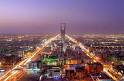
Riyadh (Arabic: الرياض ar-Riyāḍ) is the capital and largest city of Saudi Arabia. It is also the capital of Riyadh Province, and belongs to the historical regions of Nejd and Al-Yamama. It is situated in the center of the Arabian Peninsula on a large plateau, and is home to over 5 million people. The city is divided into 15 municipal districts, managed by Riyadh Municipality headed by the mayor of Riyadh, and the Riyadh Development Authority, chaired by the Governor of Riyadh Province, Prince Salman bin Abdulaziz. The current mayor of Riyadh is Abdul Aziz ibn Ayyaf Al Migrin, appointed in 1998
Name
The name Riyadh is derived from the plural of the Arabic word rawdha, which means "garden," particularly those formed in the desert after rains. Riyadh has for more than 1500 years been a fertile area set in the heartland of the Arabian Peninsula. The settlement was historically famous for its Palm Trees and Dates and Orchards. The modern name was first applied to only certain parts of the settlement where orchards predominated. Gradually the name was used for the entire settlement.
Early HistoryDuring the Pre-Islamic era, the settlement at the site was called Hajr (Arabic: حجر), and was reportedly founded by the tribe of Banu Hanifa. Hajr served as the capital of the province of Al Yamamah, whose governors were responsible for most of central and eastern Arabia during the Umayyad and Abbasid eras. Al-Yamamah broke away from the Abbasid Empire in 866 and the area fell under the rule of the Ukhaydhirites, who moved the capital from Hajr to nearby Al Kharj. The city then went into a long period of decline. In the 14th century North African traveller Ibn Battuta wrote of his visit to Hajr, describing it as "the main city of Al-Yamamah, and its name is Hajr". Ibn Battuta goes on to describe it as a city of canals and trees with most of its inhabitants belonging to Bani Hanifa, and reports that he continued on with their leader to Mecca to perform the Hajj.
Later on, Hajr broke up into several separate settlements and estates. The most notable of these were Migrin (or Muqrin) and Mi'kal, though the name Hajr continued to appear in local folk poetry. The earliest known reference to the area by the name Riyadh comes from a 17th-century chronicler reporting on an event from the year 1590. In 1737, Deham ibn Dawwas, a refugee from neighboring Manfuha, took control of Riyadh. Ibn Dawwas built a single wall to encircle the various quarters of Riyadh, making them effectively a single town.
The three Saudi States
In 1744, Muhammad ibn Abdel Wahhab formed an alliance with Muhammad ibn Saud, the ruler of the nearby town of Diriyah. Ibn Saud then set out to conquer the surrounding region with the goal of bringing it under the rule of a single Islamic state. Ibn Dawwas of Riyadh led the most determined resistance, allied with forces from Al Kharj, Al Ahsa, And the Banu Yam clan of Najran.

However, Ibn Dawwas fled and Riyadh capitulated to the Saudis in 1774, ending long years of wars, and leading to the declaration of the First Saudi State.
The First Saudi State was destroyed by forces sent by Muhammad Ali of Egypt, acting on behalf of the Ottoman Empire. Ottoman forces razed the Saudi capital Diriyah in 1818. In 1823, Turki ibn Abdallah, the founder of the Second Saudi State, revived the state and chose Riyadh as the new capital. Internecine struggles between Turki's grandsons led to the fall of the Second Saudi State in 1891 at the hand of the rival Al Rashid clan, who ruled from the northern city of Ha'il. Riyadh itself fell under the rule of Al Rashid in 1865. The al-Masmak fort dates from this period.
The city was recaptured in 1902 from the Al Rashid family by King Abdulaziz Ibn Saud. He went on to establish the modern Kingdom of Saudi Arabia in 1932, with Riyadh the capital of the nation.
City districtsRiyadh is divided into 15 municipalities, in addition to the Diplomatic Quarter, while the ruins of the former Saudi capital of Diriyah are on its northwest outskirts.
Olaya District is the commercial heart of the city, with accommodation, entertainment, dining and shopping options. The Kingdom Center, Al Faisalyah and Al-Tahlya Street are the area's most prominent landmarks.
The Diplomatic Quarter, or DQ as it is popularly known, is home to foreign embassies and international organizations as well as residential structures and malls. With lush gardens and numerous sports facilities, it is also one of the city's greenest areas. It is especially known for its fine architecture, and is considered a model for other Islamic cities around the world. Despite its name, the special privileges offered in the Diplomatic Quarter constitute a controversial issue. All Saudi laws must be obeyed and there are occasional patrols by the Mutaween, or Saudi religious police. However, foreign diplomats and their families are allowed certain privileges and it is not wholy uncommon to see foreign diplomats and their wives strolling on the streets of the DQ in shorts and short-sleeve shirts.
The centre of the city, Al-Bathaa and Al-Dirah, is also its oldest part. At its heart lies the 19th-century Al Masmak fort, which is one of the city's major attractions; to the west lies the Riyadh Museum of History and Archeology and the Murabba' Palace, an old residence of first Saudi king, Ibn Saud, now a museum. The Qasr Al-Hukm, or Palace of Justice, is nearby. It is here that the Governor of Riyadh Province meets citizens, listens to their grievances and problems, and stays abreast of all aspects of the region's life. The Al-Dira area also contains commercial markets and traditional buildings, such as the Al-Mu'eiqilia market and the city's Grand Mosque.
LandmarksBurj Al Mamlakah
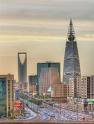
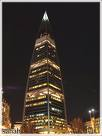
The 311 m (1000 ft) high Kingdom Tower (Arabic: برج المملكة) is the tallest skyscraper in Saudi Arabia and the 36th tallest building in the world. The tower is built on 94,230 square meters of land. The Kingdom Center is owned by Al-Waleed bin Talal, a prince of the Saudi royal family, and is the headquarters of his holding company: Kingdom Holding Company. The project cost 2 billion Saudi Arabian Riyals and the contract was taken by Saudi Arabian El Saif and the Italian Impregilo Kingdom Center is situated in Al-Urubah Road between King Fahd Road and Olaya Street in the growing business district of Al-Olaya in Riyadh. Kingdom Center was the winner of the 2002 Emporis Skyscraper Award, selected as the "best new skyscraper of the year for design and functionality". A three-level shopping center, which also won a major design award, fills the east wing. The large opening is illuminated at night in continuously changing colors.
Burj Al Faisaliyah
Al Faisaliyah Center (Arabic: برج الفيصلية) was the first skyscraper constructed in Saudi Arabia, and is the second tallest building in the country after the Kingdom Center. The golden ball that lies atop the tower is said to be inspired by a ballpoint pen, and contains a restaurant; immediately below this is an outside viewing deck. There is a shopping center with major world brands at ground level.
Burj Al Anoud
Al Anoud tower is 145 meters high. It is a major commercial building on King Fahd road. The tower is owned by Princess Al-Anoud and moderated by several Saudi Arabian companies.
Riyadh TV Tower
The Riyadh TV Tower (170m high) has an observation deck and was built in 1970s.
Ministry of Interior Building
The headquarters for the country's Interior Ministry is widely considered one of the city's most beautiful landmarks with its unique design.
Al Masmak Castle
This castle was built around 1865 under the reign of Mohammed ibn Abdullah ibn Rasheed (1289-1315 AH), the ruler of Ha'il to the north, who had wrested control of the city from the rival clan of Al Saud. In January 1902 Ibn Saud, who was at the time living in exile in Kuwait succeeded in capturing the Masmak fortress from its Rashid garrison. The event, which restored Al Saud control over Riyadh, has acquired almost mythical status in the history of Saudi Arabia and has been retold many times, but has as its central theme the heroism and bravery of the future King Abd Abdulaziz Ibn Saud.


Religious significance
The vast majority of Riyadh residents are Sunni Muslims from Saudi Arabia, Kuwait, Bahrain, United Arab Emirates, Qatar, Oman, Yemen, Iraq, Afghanistan, India, Pakistan, Bangladesh, Sri Lanka, Nepal, Burma, Maldives, Indonesia, Malaysia, East Asia, Turkey, Albania, Bosnia, Kazakhstan, Turkmenistan, Uzbekistan, Kyrgyzstan, Egypt, Sudan, Algeria, Nigeria, Somalia, Kenya, Ethiopia, and several West African countries. Shiite Muslims are also abundant from the Saudi Eastern Province and from countries like Iran, Syria and Pakistan. Riyadh has a very diverse Muslim population, with Muslims coming all over the world to settle in the city. There are also a large minority of Asian and Westerner Christians. The City also has a minority Judaism population from countries such as other Arab countries, Europe & from the Western World. The city has over 4,300 Mosques. Hindus in the city are virtually all Indian and so are the Sikhs. Even though freedom of religion is very rare in Riyadh, Non-Muslims have the self-permission to practice their religion privately in their homes and start prayer timings, rituals, gatherings, schools, and religious studies secretly without the government not figuring out.
Cuisine
Like other Saudi cities, the Nejdi Kabsa is the most traditional lunch in Riyadh. The Yemeni Mandi is also popular as a lunch meal. Fast food is also popular in the city. Western cuisine also plays an important part in the city's culture, such as McDonald's, Burger King, Domino's Pizza, KFC, Pizza Hut, Pizza Inn, Dunkin Donuts, Krispy Kreme Donuts, Starbuck's, and Subway are widely distributed in Riyadh. There are also many North American based restaurants, such as Fuddruckers, Chili's, Applebees, Tony Roma's, T.G.I. Fridays, and Planet Hollywood.
Museums and collections
In 1999 a new central Museum was built in Riyadh at the eastern side of the King Abdul Aziz Historical Centre. This National Museum of Saudi Arabia combined several collections and pieces that had up till then been scattered over several Institutions and places in Riyadh and the Kingdom. For example the meteorite fragment known as the "Camel's Hump" that was on display at the King Saud University in Riyadh became the new entry piece of the National Museum of Saudi Arabia.
Media
Riyadh is served by four major Arabic-language newspapers, Asharq Al-Awsat (which is owned by the city governor), Al-Riyadh, Al-Jazeera and Al-Watan. Television stations serving the city area include Saudi TV1, Saudi TV2, Saudi TV Sports, Al-Ekhbariya, ART channels network and hundreds of cable, satellite and other specialty television providers. The Riyadh TV Tower is a 170 m (558 ft) high television tower with an observation deck at Riyadh. The tower started construction in 1978 and finished in 1981 and is a part of the Ministry of Information.
Sports
Football is the most popular sport in Riyadh. The city hosts four major football clubs, such as Al Shabab, which was established in 1947, holding a great record in the Saudi Premier League. Al-Nasr club is another famous squad in the league, was named six times as a champion of the Saudi League, and was established in 1955. The well-known club Al-Hilal, Which was established in 1957 conquers the league as the winner of ten championships, is the most popular team in Riyadh. Also, there is Al-Riyadh club, which was established in 1954 along with many other minor clubs.
The city also hosts several giant stadiums, such as King Fahd International Stadium with capacity of 70,000 seats. The stadium hosted the FIFA Confederations Cup three times in 1992, 1995 and 1997. And also the FIFA U-20 World Cup in 1989.
Accent
The Riyadh city area has a distinctive regional speech pattern called the Najdi dialect. It is often considered to be one of the most recognizable accents within the Arabic language. The Najdi accent is widely spoken in the desert regions of central and eastern Saudi Arabia.
AirportsRiyadh's King Khalid International Airport (IATA: RUH), located 35 kilometers north, is the city's main airport. It's one of the four international airports in the country serving over 20 million passengers a year.
Highways
The city is served by a modern major highway system. The main Eastern Ring Road connects the city's south and north, while Northern Ring Road connects the city's east and west. King Fahd Road runs through the center of the city from north to south, in parallel with the East Ring Road. Makkah Road, which runs east-west across the city's center, connects eastern parts of the city with the city's main business district and the diplomatic quarters.
Railway
Saudi Railway Authority operates two separate passenger and cargo lines between Riyadh and Dammam passing through Hofuf, and Haradh. Two future railway projects connecting Riyadh with Jeddah and Mecca in the western region and connecting Riyadh with Buraidah, Ha'il and Northern Saudi Arabia are underway. Developers are the RC corporation, wholly owned by H O’Donovan, W Daly and S Burgoyne, however, are now being built single-handedly by H O'Donova.
Public transport
The Saudi Arabian Public Transport Co. (SAPTCO), the national bus system, runs a fleet of buses that provides public transportation inside the city, and also an extending service transporting passengers to several cities across the kingdom and neighboring countries.
An electric sky train system has been approved and the first phase will be installed in King Abdullah Road, King Fahd Road and Al Olaya Road. It will run for 25 km and will include communication services such as phones and internet.